AI is setting us up for a huge mid-level talent problem. How we approach entry-level talent is the key to solving it.
My first post-college job search was frustrating and painful. Unfortunately, it seems the only thing that has changed about the entry-level job search process is the technology involved, because this slightly more recent meme still sums up my feelings perfectly:
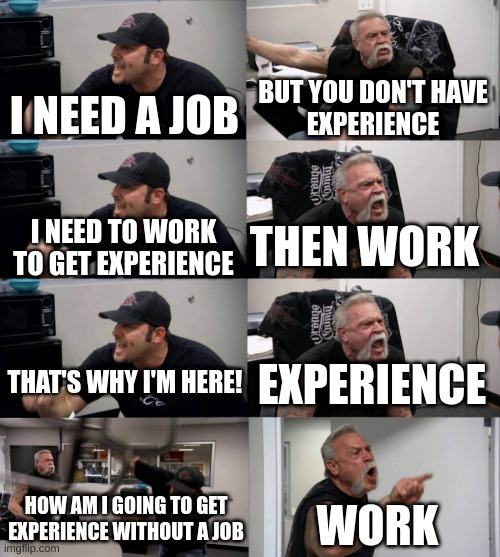
You need experience to get a job, but you can’t get experience without a job. Infuriating circular logic for emerging adults everywhere.
Full disclosure: I think AI in its current form has made the hiring process worse for everyone. It’s easier than ever to update your resume, draft a cover letter, and quickly* apply to tons of open positions with your materials tailored to each one. For recruiters and hiring manager, that means tons more content to sift through, plus needing to figure out how to tell which ones are truly strong applicants versus AI-generated BS. In theory, AI can help analyze the applications to give you a shortlist of top applicants, but keep in mind that AI models are trained on existing human-generated text, with all its flaws and biases baked in. It’s going to take some solid prompt engineering skills to pull a good variety of quality candidates from the stack. I do think AI has potential to transform the hiring process for the better, but not the way it’s been implemented so far.
*I use the term “quickly” loosely, because there are somehow still an astounding number of applicant tracking systems that ask you to upload your resume and then still require you to type a lot of that same information into their system.
Candidates with work experience still have some advantages in this frustrating scenario, because they can “check the box” on the years of work experience bullet point. Entry-level applicants have, at best, internship experience, which is often stints of less than a year, which AI models could also read as frequent job changes, a potential red flag. (And don’t even get me started on the entry-level job postings that ask for multiple years of experience…)
In addition, entry-level applicants are just starting to build their networks, so they are far less likely to have a personal connection in their corner to put in a good word with the hiring manager to help get their resume pulled from the digital stack. And now, there’s lots of talk about AI replacing many entry-level roles altogether. Though it may be overhyped in the headlines just a tad, there are undoubtedly leaders who will plan to replace people with AI in pockets of their organizations. I suspect too many of these leaders will not fully think through the logistics or implications of those decisions, but either way, young adults will feel a lot of the impacts. So if you’re out there looking for your first full-time job, what the heck are you supposed to do now? I do think getting back to some basics can help, such as demonstrating responsibility, trustworthiness, and other general characteristics that show you can be counted on in a work setting, but I think organizations have a lot to lose if they don’t do things differently as well.
In particular, I don’t think enough people are thinking ahead to what this will mean for organizations’ mid-level talent pools a few years from now. When you’ve replaced entry-level positions with AI and your mid-level talent leaves, you’re left with no one to promote from within. That means you have to look externally for experienced talent, incurring the additional recruiting and hiring costs that come with it. External hires can bring wonderful skillsets and fresh perspectives, but they also bring the trade-off of needing time to onboard to the organization and learn the internal acronyms and contexts before they can fully put those skills and perspectives to use. All the while, we’ve got many potentially great employees still stuck on the sidelines because of this no job without experience, no experience without a job conundrum that now has even fewer opportunities to escape.
Fortunately, I think there are some actions that organizations and entry-level applicants can take to avoid this mid-level talent gap problem and set themselves up for a better future.
For organizations:
Identify the true entry-level roles. Job titles are not always intuitive, and can vary tremendously from company to company. Where are specific skills and experiences more of a nice-to-have than truly necessary to do the job? If no existing positions fit the bill, determine how you would expect applicants to gain that experience and what you might do to facilitate that. Think beyond traditional 4-year degree intern-to-hire programs and consider apprenticeship and partnership models. If students are graduating from academic programs underprepared, explore opportunities to work with those programs in ways that close those gaps.
Re-imagine paths to promotion. Large organizations typically have established job titles and structured sequences, but lateral moves can also add valuable experience for both the organization and the employee. Document multiple possible paths from general entry-level roles into different career specialties, so employees can know what to focus on based on where they want to go. For example, if someone’s goal is to become a Data Scientist, and there are no longer entry-level data science positions, what other areas of the company could give them industry and context experience that would make them ready for mid-level? Show employees how one could combine that path with focused tech tool upskilling to move into their target role. In one of my previous companies, call center employees gained a tremendous amount of product and system knowledge they could easily apply in different areas of the company. Providing paths from a role like that to different higher-demand mid-level positions, rather than simply highlighting anecdotes of individual employees who forged their own different routes, will make these possibilities more accessible to more people in the organization.
Hire for transferable skills. The value of transferable skills like communication, collaboration, and problem-solving is often talked about but can easily get de-prioritized in favor of experience with specific tasks, tools, or platforms. Flip the script and focus on finding candidates that demonstrate the broader skills and qualities the organization values most, such as continuous learning, applying feedback, and adapting to change. It’s much easier to help someone reliable and adaptable learn a new tool or coding language than to get someone highly proficient in a specific tool to change the way they communicate (and I speak from experience on this one!)
Accept some development responsibility. I constantly see clickbait headlines about all the reasons managers are fed up with Gen Z employees and all the ridiculous things they do, and I have to laugh a little because I remember very similar complaints made about Millennials when I was starting my career (and I also remember being confused, because I thought I had done everything I was supposed to do and then some, and I still had a hard time adjusting to full-time work life). It’s easy to forget all the implicit norms we’ve absorbed and accepted over the years, but it’s not reasonable to expect entry-level employees to have that all sorted out before they walk in the door. Someone has to be willing to teach them. (The amount of resources out there about writing good prompts for AI tells me we are willing to spend time writing and revising instructions for chatbots, so surely we can do the same for our fellow human beings!) Yes, parents and post-secondary programs should be doing some of this work, but you’re still bringing someone into a new environment. They won’t always get it right, but give them the opportunity and support so they can learn from those mistakes. Be willing to learn things from entry-level hires as well; they’ve got different perspectives to share and might have ideas worth exploring (some good examples about this in a recent HBR Ideacast episode.) After all, we know “that’s the way we’ve always done it” logic doesn’t suffice unquestioned anymore, particularly in the age of AI.
For entry-level applicants:
Do your research (and cite your sources). What should you expect in an entry-level salary, benefits package, work setting, etc. based on the company or industry you’re focusing on? Between AI and the internet, it’s easier than ever to find this information. Use it as a starting point, and reference it as your reasoning if you’re asking for something different than what an organization is offering or expecting. You won’t necessarily get everything you ask for, but an informed request is thoughtful, professional, and very contrary to the sense of entitlement people like to complain about.
Demonstrate transferable skills. Maybe you’re applying for a data analyst job and have never used Power BI, but you did work with teammates in a class or internship to prototype and build data visualizations in Excel or Tableau. Explain how you coordinated with others, managed your timeline, conducted testing and troubleshooting (trust me, there’s always something that ends up looking weird and needing to be checked). What pieces of that process would apply to the next prototype you build, even if it’s in a different tool? Share examples from school, work, and/or extracurricular activities that show your best qualities as a potential employee and how you think you could apply those in a new setting.
Never stop learning. Learning does not have to mean formal education, but always be willing to learn new things. A lot of the tools I use in my work today did not exist when I was in high school or college, but I stayed curious and learned new things on my own, as part of my work, and through coworkers and mentors. That learning has opened up opportunities I wouldn’t even have known to imagine when I was first starting out. We know technology is going to continue to bring about change, so learning how to learn is going to be your most “future-proof” skill.
Work and careers in the age of AI has many challenges ahead. We need to be willing to rethink how we approach early career education, training, and hiring to avoid a looming mid-level talent gap. I think we have the best chance to see positive impacts from AI if we don’t lose sight of the humans involved. Yes, we are messy and complex compared to a neat and tidy AI-generated response, but we’re also full of unique possibilities and promise that could lead to better outcomes than any AI model has been trained on.